How Long Does It Take to Drive Route 66?
You could technically cover Route 66 much faster than this. But that rather misses the point.
Route 66 isn't really about getting from Santa Monica to Chicago. It's about everything that survives between them.
Old gas stations. Neon motel signs. Diners that have been flipping burgers for generations. Main streets bypassed by the interstate. Giant roadside attractions that make absolutely no sense until you're standing underneath one.
Two weeks is often recommended for a Route 66 road trip, and three would give you considerably more time to explore. But 11 days is enough to experience the full route without turning every day into an endurance drive.
It does require some choices. You won't visit every museum or stop at every historic gas station. Some towns deserve a few hours; others are perfect for little more than lunch and a walk around.
That's part of the appeal.
Route 66 is one of those journeys where sometimes the places you didn't plan to stop become the ones you remember most.
Day 1: Santa Monica to the Mojave Desert
There could hardly be a more dramatic place to begin.
Start beside the Pacific at Santa Monica Pier, beneath the famous Route 66 End of the Trail sign.
Except this time, it isn't the end.
It's mile zero.
From Santa Monica, head inland and watch Los Angeles gradually disappear behind you, trading palm trees and coastal air for mountains, desert and increasingly enormous skies.
If you're tackling Route 66 in an RV, this first stretch is also a chance to find your rhythm. Manoeuvring a motorhome through Southern California traffic might not be the romantic Route 66 experience you imagined, but once the city begins to thin out, everything changes.
Into the Mojave
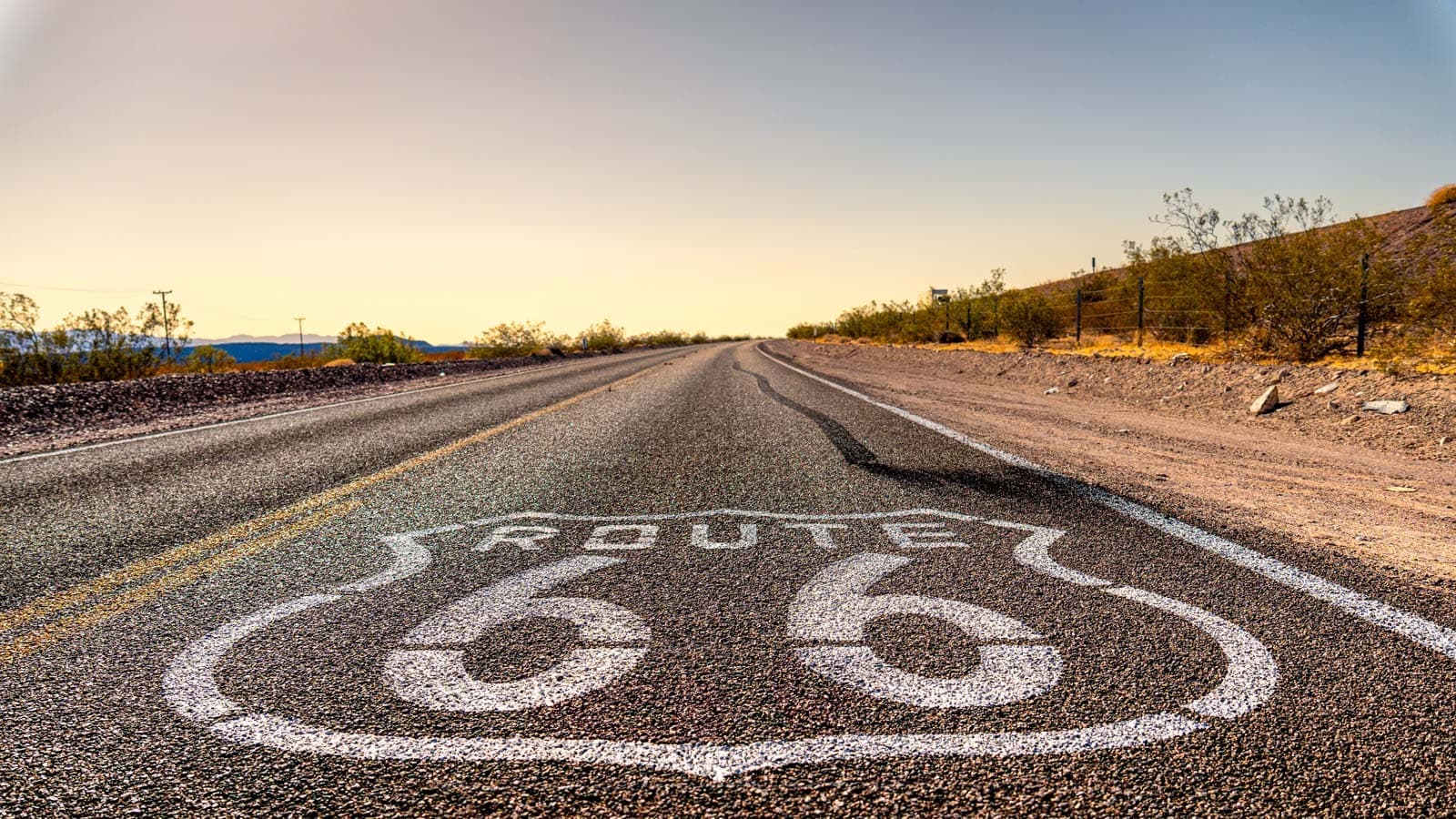
By the time you reach the Mojave, Route 66 starts to resemble the America people picture before making this trip.
Long stretches of road disappear towards the horizon. Freight trains roll alongside you. Old businesses appear almost from nowhere and vanish just as quickly in the mirrors.
Pass through Barstow, one of the classic Californian Route 66 towns, and seek out sections of the old highway where the interstate suddenly feels a very long way away.
There's no need to fill the afternoon with attractions.
The desert is the attraction.
Day 2: California to Arizona via Oatman and Kingman
Continue east towards the Arizona border before turning towards Oatman, an old mining town in the Black Mountains that has become equally famous for the wild burros wandering its streets.
Calling Oatman unusual doesn't quite cover it.
Old western-style buildings line the main street, burros casually wander between visitors, and the road approaching town twists through a landscape that feels completely removed from the modern interstate nearby.
From Oatman, continue to Kingman, one of Arizona's best-known Route 66 stops, before following the old road towards Seligman.
Seligman: Where Route 66 Refuses to Die
Seligman is gloriously over the top.
Vintage cars, old signs, mannequins, neon, souvenir stores and Americana spill along the roadside. If you've come searching for subtlety, you've taken the wrong road.
But there's a reason this little town has become such an important stop on Route 66.
Seligman played a major role in preserving the identity of Historic Route 66 after Interstate 40 bypassed communities along the old road. Today, it remains one of the best places to experience the colourful, eccentric side of the Mother Road.
Take some time to wander before continuing east towards Flagstaff, where the desert landscape gradually gives way to pine forest.
It's hard to believe you're still in Arizona.
Day 3: Flagstaff, Winslow and the Petrified Forest
Leave Flagstaff early and continue east towards Winslow, a town that has turned a single line from an Eagles song into an entire attraction.
Yes, you should stand on the corner.
Of course you should.
From Winslow, the landscape opens up again as Route 66 continues towards Petrified Forest National Park.
Petrified Forest National Park
This is one stop worth giving more time.
The park protects an extraordinary landscape of colourful badlands, desert and enormous deposits of petrified wood, with historic Route 66 once cutting directly across the area.
After a few days dominated by diners, signs and roadside Americana, it's also a reminder that some of the greatest sights along Route 66 have nothing to do with the highway itself.
Continue towards Holbrook, another town steeped in Route 66 nostalgia, before eventually crossing the state line into New Mexico and making your way towards Gallup.
Three states down. Five still to come.
Day 4: Gallup to Albuquerque and the Neon of Tucumcari
New Mexico is one of the most spectacular sections of the entire Route 66 road trip.
There's something about the combination of desert, mountains, adobe architecture and enormous skies that makes driving here particularly memorable.
Head east from Gallup towards Albuquerque, where historic Route 66 cuts through the city along Central Avenue.
Take some time to explore, grab something to eat and stretch your legs before continuing east.
The real target for the evening lies farther along the road.
Tucumcari After Dark
If there's one Route 66 town worth arriving in after sunset, it's Tucumcari.
During the day, it can feel sleepy.
At night, the neon comes alive.
Old motel signs glow beside the highway, including some of the most recognisable surviving neon on Route 66. The famous Blue Swallow Motel is among the stars, its neon sign recalling the golden age when Route 66 motorists filled the roadside motels each evening.
Slow down and take your time driving through town.
If you've come looking for the Route 66 you've seen in old photographs, this is about as close as it gets.
Day 5: New Mexico to Texas and Cadillac Ranch
Continue east from Tucumcari and cross into the Texas Panhandle.
There's one destination outside Amarillo that's almost impossible to miss.
Cadillac Ranch is ridiculous.
Ten Cadillacs buried nose-first in a field shouldn't be one of America's great roadside attractions.
And yet, somehow, it works.
Pull over, walk out into the field and join generations of Route 66 travellers who have stopped here to photograph and spray-paint the cars.
Amarillo and the Texas Panhandle
Amarillo delivers another dose of oversized Route 66 Americana.
The Big Texan Steak Ranch is perhaps best known for its infamous 72-ounce steak challenge, but even if you have absolutely no intention of attempting it, the place is worth seeing.
Everything is big, loud and unapologetically Texan.
From Amarillo, continue east through the Panhandle towards Shamrock, where the beautifully restored Art Deco U-Drop Inn looks like something designed for a movie set.
Except it has been standing beside Route 66 since the 1930s.
Day 6: El Reno, Oklahoma City and Tulsa
Oklahoma has more driveable miles of historic Route 66 than any other state, so this isn't the day to simply jump onto the interstate and race east.
And there's one particular town worth driving into hungry.
Stop for an Onion Burger in El Reno
El Reno is synonymous with Oklahoma's fried onion burger.
The dish emerged during the Depression era, when onions offered an inexpensive way to stretch ground beef further. What began out of necessity became a local institution.
Stop at Sid's Diner, where beef patties hit the griddle beneath a mound of thinly shredded onions until the beef, onion and caramelised edges essentially become one glorious mess.
It isn't sophisticated.
It's not supposed to be.
A fried onion burger in a small-town Oklahoma diner is exactly the sort of meal that belongs on a Route 66 road trip.
From El Reno, continue through Oklahoma City before heading northeast towards Tulsa.
Route 66 Through Tulsa
Tulsa feels different from many of the smaller Route 66 communities along the journey.
There's plenty of history here, but also a new generation embracing the road rather than simply preserving it.
Explore sections of the historic route, find some of the city's neon, pass the enormous Golden Driller and stop by the wonderfully bizarre Buck Atom's Cosmic Curios.
Tomorrow, you'll cross an entire state in a matter of minutes.
Day 7: Three States and a Night at the Wagon Wheel Motel
Leave Tulsa and head northeast until Route 66 crosses into Kansas.
The Mother Road spends only around 13 miles here.
That makes Kansas easy to dismiss, but that would be a mistake.
Route 66 passes through Galena, Riverton and Baxter Springs, creating a tiny slice of southeastern Kansas filled with old buildings, service stations and the sort of small-town character that makes this journey so rewarding.
Before long, you'll cross into Missouri.
Springfield, Missouri
Continue through Springfield, a city with a particularly strong claim to Route 66 history. It was here in 1926 that officials proposed the number “66” for the new Chicago-to-Los Angeles highway.
But don't stop for the night just yet.
There's somewhere farther along the road that's worth leaving the RV for.
Park the RV and Stay at the Wagon Wheel Motel
An RV gives you enormous freedom on Route 66.
But there's at least one night when it's worth abandoning your travelling bedroom.
In Cuba, Missouri, park the RV and check into the Wagon Wheel Motel, one of the great surviving icons of Route 66.
The motel dates back to the 1930s, with its historic stone buildings arranged around the famous neon sign. It's the kind of place that could easily have disappeared when travellers migrated to the interstate, yet it remains part of the Route 66 experience today.
After a week of carrying your accommodation around America, sleeping in a genuine Route 66 motel is a fitting change.
If you're going to drive the Mother Road, you should spend at least one night beneath the glow of an old neon motel sign.
Day 8: Cuba to St. Louis
Before leaving Cuba, take some time to explore.
The town is known as Route 66 Mural City, with large murals scattered around its streets depicting stories and characters from the area's history.
Then continue east towards the biggest city you've seen for several days.
St. Louis and the Gateway Arch
Seeing the Gateway Arch rise into view feels like another milestone.
California, Arizona and New Mexico are well behind you now. So are the Texas Panhandle, Oklahoma and the blink-and-you'll-miss-it Kansas stretch.
You're unmistakably in the Midwest.
Spend some time exploring St. Louis, seek out sections of historic Route 66 and make room for another local institution: frozen custard at Ted Drewes.
By this stage of the journey, food becomes almost as effective at charting your progress across America as the state lines.
Day 9: St. Louis to Springfield, Illinois
Crossing the Mississippi River brings you into Illinois, the eighth and final state of the road trip.
Chicago is getting close.
But Illinois contains one of the most rewarding stretches of Route 66, particularly if you resist the temptation to simply race north.
Small towns, restored filling stations, giant roadside characters and old diners appear regularly along the historic route.
Head towards Springfield, Illinois' state capital and a city inextricably linked with Abraham Lincoln.
Stop for a Cozy Dog on Route 66
For lunch, there's an obvious Route 66 choice.
Cozy Dog Drive In has been serving its famous hot dogs on sticks to Route 66 travellers for generations.
It's quick, unpretentious and exactly the sort of lunch this road trip is all about.
At some point on Route 66, you stop searching for the “best restaurant” in each city and start looking for somewhere that belongs to the road.
There's a difference.
Day 10: Springfield to Chicago
The final driving day begins in Springfield and continues north through Illinois.
But don't rush it.
Stop in Pontiac, one of the most enjoyable Route 66 towns in the state, before continuing towards Joliet.
Gradually, the landscape begins to change.
Traffic returns. Buildings become denser. The enormous skies and empty roads that define so much of the journey start disappearing.
Chicago is ahead.
Reaching the Beginning of Route 66
And then, suddenly, you've done it.
You've driven Route 66 from Santa Monica to Chicago.
Historically, the famous highway begins in downtown Chicago near the intersection of Adams Street and Michigan Avenue. For westbound travellers, it's where the adventure starts.
On this itinerary, it's the finish line.
There's something particularly satisfying about ending among skyscrapers after beginning beside the Pacific Ocean.
Behind you are around 2,448 miles of America.
Eight states.
Desert highways and Midwestern main streets. Neon motels. Onion burgers. Cadillac Ranch. Wild burros. Petrified forests. Tiny Kansas towns. And an RV that's somehow started to feel like home.
Park it.
For once, there's nowhere else you need to drive.
Day 11: Chicago and the End of Route 66
Keep the final day free.
No RV miles. No rushing towards another state line. No roadside attraction 80 miles down the highway that absolutely has to be seen.
Just Chicago.
After ten days of watching towns appear and disappear through a windscreen, being able to explore on foot feels surprisingly good.
Walk downtown, spend some time along the lakefront and return to the Route 66 signs that mark the historic beginning of the highway.
Driving Route 66 west-to-east might be unconventional, but there's something wonderfully cinematic about doing it this way.
Santa Monica provides the Pacific Ocean send-off. California and Arizona lead into vast desert landscapes. New Mexico and Texas bring neon and roadside Americana. Oklahoma, Kansas and Missouri reveal another side of the Mother Road before Illinois gradually delivers you into one of America's great cities.
Santa Monica feels like the beginning of an adventure.
Chicago feels like you've crossed a continent.
Is 11 Days Enough for Route 66?
Yes, but it's a relatively fast way to drive the entire route.
Would 14 days give you more time? Absolutely.
Could you spend three weeks exploring every museum, historic filling station, roadside attraction and small town? Easily.
But 11 days is enough to drive Route 66 without feeling as though the entire trip happened through the windscreen.
There will be some longer driving days. There will be attractions you skip. There will be towns where you spend hours and others where you barely stop.
That's part of a road trip.
If you have less than 10 days, consider tackling only a section of Route 66 rather than rushing the entire highway. With around 10 to 14 days, driving the full route becomes considerably more enjoyable.
The Perfect 11-Day Route 66 Itinerary
For anyone planning to follow this Route 66 road trip from Santa Monica to Chicago, the complete itinerary looks like this:
Day 1: Santa Monica → Barstow and the Mojave Desert
Day 2: Barstow → Oatman → Kingman → Seligman → Flagstaff
Day 3: Flagstaff → Winslow → Petrified Forest → Holbrook → Gallup
Day 4: Gallup → Albuquerque → Tucumcari
Day 5: Tucumcari → Amarillo → Shamrock
Day 6: Shamrock → El Reno → Oklahoma City → Tulsa
Day 7: Tulsa → Kansas → Springfield → Cuba
Day 8: Cuba → St. Louis
Day 9: St. Louis → Springfield, Illinois
Day 10: Springfield → Pontiac → Joliet → Chicago
Day 11: Chicago
It's a relatively fast Route 66 itinerary, but one that still leaves room for the experiences that make the Mother Road worth driving in the first place.
Is an RV a Good Way to Drive Route 66?
An RV is a brilliant way to experience Route 66.
You're not tied to hotel check-in times, and you have somewhere to make coffee, grab food or simply stop for a while whenever the road gets long.
More importantly, an RV suits the spontaneity of Route 66.
See an old sign? Pull over.
Find a strange roadside attraction that wasn't on the itinerary? Stop.
Want to stay somewhere longer than expected? You can.
There are practical considerations. An RV isn't nearly as easy to manoeuvre through Los Angeles or downtown Chicago as a car, and some older sections of Route 66 require a little more planning.
But once you reach the open road, it makes perfect sense.
And when you reach Cuba, Missouri, leave it parked for the night and check into the Wagon Wheel Motel.
Some Route 66 experiences are simply too good to skip.
The Best Stops on This Route 66 Road Trip
Picking one standout attraction on Route 66 is almost impossible because the road isn't really defined by a single blockbuster sight.
But a few stops deserve to be near the top of any itinerary.
Oatman is one of the strangest and most entertaining towns along the route. Tucumcari after dark delivers the neon Route 66 seen in countless old photographs. Petrified Forest National Park provides some of the most spectacular landscapes of the journey. El Reno offers one of its quintessential meals. Cadillac Ranch is every bit as weird as you'd expect.
And spending a night at the Wagon Wheel Motel in Cuba provides something an RV can't: the chance to actually sleep inside a piece of Route 66 history.
But don't become so focused on the famous stops that you miss everything between them.
An empty road disappearing into the desert.
Coffee beside the RV before anyone else seems to be awake.
A faded sign advertising a business that's somehow survived another decade.
Freight trains running alongside the highway.
Pulling into a town you've never previously heard of and wondering what you'll find.
Those are the moments that make Route 66.
Why Route 66 Is Still Worth Driving
Route 66 officially disappeared from the U.S. Highway System in 1985.
Yet somehow, it never really went away.
In 2026, the Mother Road celebrates its 100th anniversary, and perhaps that's the most remarkable part of its story. A highway that technically no longer exists continues to draw travellers from around the world.
It's easy to understand why.
You can drive faster roads across America. You can fly over the entire thing before lunchtime.
But neither will take you through the America that Route 66 reveals.
The old diners and motels matter. So do the neon signs, restored gas stations and wonderfully ridiculous roadside attractions. But the real magic is found in the communities between them.
Route 66 encourages you to leave the interstate, slow down and drive through places most travellers now bypass.
And somewhere between Santa Monica and Chicago, that stops feeling like the slower way across America.
It becomes the entire reason for going.